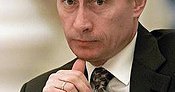
Putin - a new kind of leader
Most of Putin’s fascination stands out by contrast to the usual Russian political gerontocracy whose most eminent members provoked much mockery of their senility. Yuri Andropov died after less than two years in office and his successor Konstantin Chernenko endured all 16 months before his demise. Yeltsin, repeatedly inebriated, once failed to come out from a plane for an official meeting and on another case fell from a bridge. His slumbering, dragging gait didn’t raise analogies with the fearful Russian Bear but spoke of a weak heart. Placed in the company of such feeble old men Putin is easy to be taken for Superman. He is young and slender, practices judo (he is currently a black belt) and is a fan of horse racing. As one laudatory article notes: “Vladimir Vladimirovich also does things on his own - flying the airplanes, leading the ships, guiding the tanks…”
Boris Yeltsin introduced him to the Russian people by saying that "he will be able to unite around himself those who will revive Great Russia in the new, 21st century". By waging a psychological war with Europe and Russia’s so called “near abroad” over oil and gas supplies, Putin wants to revive the persistent European fear of Russian brute force and to remind them of their dependency on Russia. When he accepted the leaders of the newly-elected Palestinian Islamist terrorist group Hamas in time when the EU and the US cut all funds to the Palestinian Authority, Putin sent a sign that he is not amenable to the demands of his Western partners and that Russian politics is not a conformist one.
“Russia’s main goal is to find its place, not on the margins of world policy, but as part of the civilized world together with the U.S. and Europe”Sergei Chugrov, a senior researcher with the Institute of World Economy
Putin on the world stage
Putin supported the US–led invasion of Afghanistan in the wake of the September 11th attacks, but bitterly opposed to the following war on Iraq. He reconciled himself with the loss of Central Europe and the Baltic states and at the same time increased the pressure over Belarus and Ukraine. He claims that “Russia is a part of European culture” and that “it is with difficulty that I imagine NATO as an enemy” but carries out an ambiguous politics with Iran and arranged a cordial reception of North Korea’s communist dictator Kim Jong-II.
Russia’s claims for uniqueness and Russia’s desire for significance should be satisfied so as to attenuate the post-Imperial complex and curb Russia’s sporadic fits of wrath and irritation. In a sense, the EU and the USA have to seduce Russia, to tame its temper, to affiliate it to Western clubs and thus control it. The full-fledged membership of Russia in the G-8 club is the result more of a political gesture than of certain fulfilled criteria, thus awarding Russia a world-recognized status, accepting her as an equal in world matters and flattering her ailing self-confidence of a significant though regional superpower.
A view from Europe
From our European watch-tower Russia is an example of sustainable non-development, of a fossilized society doomed to self-reproducing poverty and a state hermetic to outward influence. But our notion is, of course, biased. We differ in our understandings of power, politics, freedom and democracy. For instance, Putin once said that the West is misinterpreting “the strengthening of our country” as “authoritarianism”. We cannot ignore the fact that Russia has been strongest when the most repulsive despotic regimes were flourishing. What’s more important is that despite humiliations, Russian people still love their country /and authorities!/ and fear Europe.
We should appreciate the grand tectonic shift which shook Russian politics, due to Vladimir Putin as well. The one-sided, monolith, ideologically-coloured politics of Communist Russia is replaced by a more-flexible, multifaceted and interest-based approach which serves Russia better and is much more acceptable by the West. But we shouldn’t fall to the deception that Russia has changed radically.
Conclusion
Putin’s autocratic practices are far from the fanatic yearn for power inherent in his predecessors. His attitude towards European leaders is friendly and in no way can be compared to the flagrant disregard characteristic to Stalin or Brezhnev. After all, Putin shares common interests with his European counterparts – he needs European investments and goods while Europe cannot do without Russian energy resources. That may be not enough to declare him “our friend”, nor is it a reason to condemn him as a “foe”. On Putin and his legacy we may look with certain hope and big cautiousness.


1. On 30 May 2009 at 13:24, by Oleg Mosin Replying to: Vladimir Putin - friend or foe
The Putin dillema is that the former incumbent Russian president today has remained to be the most strong successful symbol of stability for many Russians: a national logotype that can ensure political longevity for any political program, even being the most helpless and unviable. The May celebrations in Russia indicated a revival of great consolidation and patriotism among common people over a victory in world war 2 who professed nostalgia for the former USSR and who think the Russia should be by any means a great powerful country again. Ruling over Russia as a Prime Minister the key element in Putin’s increasing authoritarianism is his reliance upon the militia, military and, to an even greater extent, upon Russia’s internal security affaires – FSB the analog of secret police of the Communist era. It might be said that today the activity of Russia’s democratic institutions is dismissed as a farce, while the alleged course toward suppression of freedom and human rights is perceived as an official policy priority while power continues to concentrate in the hands of Mr Putin himself. The key sources of politics are in Russia’s patriachial mentality, which unfortunately is inacceptable to understand the western system of values and ideas of freedom and democracy imperial thinking that put Russia in the centre of all Slavic world”, combining with corruption, violence, human rights violation, and disingenuous, sophisticated propaganda that were used by the party, the KGB, and the military. There certainly has been evidence of diminishing democracy since 1993 (including the use of tanks against parliament), however, it has only recently received such a critical attention among foreign and American observers. For the most part Russia follows the Universal Declaration of Human Rights to which this country is a signatory member. On paper, Russia’s human rights law is actually quite good. There is inscribled in Russian Constitution law as an example that the Russian Federation – Russia is a democratic federal law-governed state with the republican form of a government and an article 2 of Constitution of Russia Federation sygnifies: “Man, his rights and liberties are the supreme value of the state. It shall be a duty of the state to recognize, respect and protect the rights and liberties of man and citizen”. Unfortunately, the lofty ideals embodied in many of the instruments to which Russia has acceded remain to have been on paper. Thus, Russia fell 20 places - from 88th to 108th - in the “protection of property rights” category, making it among the worst out of 117 countries in the survey. Russia also fell from 84th to 102th in “judicial independence” and from 85th to 106th in “favoritism in decisions of government officials.” Although the Yukos takeover was the first positive step of the state towards renationalisation of energy resourses, to the big profit of certain closely connected Russian though to the detriment of foreign interests. Russia has remained to be among the oil reachest countries of the world. In his recent television address to Russian people, Putin said that the country while being engulfed in the finantial crisis has been growing at an average of 7 percent per year. This is a good indicator of stability for Russia oil-based economy. Experts believe, that Russia’s oil-driven economic growth further would be even higher with the proper institutional reforms, possibly reaching 7 percent annually even while being in the epoch of world financial crisis. The second point is that with Moscow leading the way, Russia is now dramatically reversing a decade-long drop in its national birthrate. Statistics shows that not only were 122.750 more birth registered in 2007 than in 2006, but the number of children boorn cast year was the highest since 1991. Officials attributed the turning birth tide due to new policies and increased economic stability in Russia. It probably has to do with improvements in living standards and economic growth. On the other positive side, the analysts praised the establishment of the Russian stabilization fund as a bulwark against a potential drop in the world price of oil. This important initiative of Russian government is arguably the most important example of economic legislation in Russia which surely would be approved in the following six presidential years.
Follow the comments: |
|
