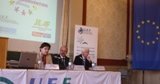
It does not come as a surprise that the timing of the event was carefully chosen to coincide with the end of the Austrian Presidency of the European Council. This way the conference approach in discussing European affairs and a direct link between the distant elitist politicians with an equally distant pro-European organisation could continue.
The two days in which, according to the objectives of the organisers, the European Citizens would have a chance to meet in the framework of a European Citizens Convention and discuss key issues of the European project, take account of any progress made in the last months and recommend future action in regard to the constitutional process, as well as the proclaimed number of having 300 participants from all over Europe (including members of the European Parliament and of national Parliaments, representatives of Civil Society and the general public) were mildly speaking far from reality.
What happened?
Actually, the Convention lasted not more than a day, since it started in late afternoon on Thursday and ended at 5 pm on Friday. But that is not necessarily a bad thing. The problematic part is the nature of the whole Citizens Convention, which in principle was supposed to be an innovative way of including various actors concerned with European issues, especially the future of Europe and its constitutional process, ranging from high ranked politicians to grass rout level organisations and activists, whether old or young.
Even though the First European Citizens Convention in Genoa back in December can be evaluated as a success and a good start this time round it all seemed to resemble too much a typical Viennese conference of high ranked politicians of different levels mixing only with members of UEF and JEF. In other words, preaching to the already convinced. No promised representatives of civil society others than the usual suspects of UEF, EMI and JEF, almost no general public attendance and little media coverage with even less output. At least the Genoa Convention came up with a manifesto.
However, if we evaluate the event as a conference then it was definitely a huge success. Good, some even very prominent, speakers (e.g. Pat Cox), very good preparation and organisation mainly by members of JEF-Austria and the UEF international, a nice reception with buffet at the marvellous Vienna City Hall and typical conference like panel discussions. A treat for every convinced European used to doing the same all over Europe.
So what was the actual theme of this Convention/conference? The organisers entitled it along Victor Hugo’s term United States of Europe, giving also homage to the Belgian Prime Minister Guy Verhofstadt and his latest book on European affairs, which carries the same title. This topic was touched upon mainly in the opening panel discussion by the speakers Didier Donfut, a Belgian State Secretary for European Affairs and Reinhard Rack, an Austrian Member of the European Parliament.
On the second day of the conference the participants were supposed to be equally divided into four working groups dealing with key issues of the European project. The four chosen topics were: European economic governance, European social model, young generation as Europe’s human potential and Europe as a power for peace. Sadly some of the WGs had very poor attendance and there was no real output, since the discussions were not streamlined or intended to have a coherent outcome but simply offered an open space for debate; which is a legitimate and worthy approach. It is just that one would expect a bit more from a so called European Citizens Convention.
Ideas for the future
Even though the Genoa Citizens’ Convention had plenty of NGO representatives involved and even had a street action, still more could be done to increase the visibility and accessibility of such events. Some practical measures on how to improve the whole concept of Citizens Convention might be taking these politicians that participated in the conference to the streets, let them talk to individuals, ask them directly what puzzles them about Europe, what they want and need; sometimes simply listening can mean more than a thousand words or slogans.
Conclusion
In the end it seems as if the pro-European organisations still have not learned their lesson from their last year’s failure in communicating the positive aspects of the EU to the broader public and ordinary citizens. Taking part in this event made me realise that we have a lot of work to do and that it is high time for us to stop preaching to the convinced but rather reach out to those who do not necessarily agree with us, but do nonetheless share our vision of a democratic, well regulated, citizens’ friendly and transparent federal Europe.
Let us not talk about the citizens but with them!


1. On 7 July 2006 at 00:28, by Valéry-Xavier Lentz Replying to: “Where are the Citizens?!”
You write :
In the end it seems as if the pro-European organisations still have not learned their lesson from their last year’s failure in communicating the positive aspects of the EU to the broader public and ordinary citizens.
But actually I am not convinced that our mission is to communicate the positive aspects of the EU, that’s the job of Margot Mallström. Our job is to point out what’s not working and why, and to convince of the solutions we propose.
The analysis of the shortcomings and the failures of the Union as it is now was actually shared by both the federalists and some of the more no-voters. We failed in convincing that the constitutional treaty was actually solving thos issues or making significant progress in solving them.
We failed becasue actually this was a leap of faith : we were faithful that this “Constitution” was a significant step forward and would allow us to carry on with progress towards federalism. Others were actually sceptical about this vision and were faithful that the only way to obtain what we hope for was to provoke a political crisis that would allow a renewed dynamism among the willings.
Obviously those who are familiar with European affairs know that this was highly unlikely but then, most voters are not experts.
This is why such an event should gather more than the traditional pro-europeans : our critical views on the way the Union work have a potenially large audience. The challenge is to make sure that this critical view of the EU leads to a federalist approcah to improve teh Union and not to a nationalist option to weaken it.
2. On 7 July 2006 at 12:11, by Peter Matjašič Replying to: “Where are the Citizens?!”
Dear Valery!
Thanks for your comment.
First on communicating positive aspects of the EU: It is true that it’s the job of Commissioner Walstroem and her cabinet to do so. But to a certain extent (sometimes whether we want to or not) also our job, since in situations like the YES and NO campaigns JEF was one of the few, if not the only part of the European civil society, that rallied for a positive image of the EU WITH REASONABLE arguments (unlike some national governments and party politicians, who made several simply unacceptable comments).
But I agree, we perhaps shouldn’t take such a big burden on our shoulders and really focus on, as you pointed out, critisizing the negative aspects while at the same time proposing better alternative solutions in a easy-to-understand/citizens’ friendly way.
Secondly, I do believe that the federalist movement has the leverage to gather seemingly opposing positions in the YES-NO debate, as long as we start thinking out of the box and present our ideas of federal institutions as the only democratic way, which can help Europe advance and then the politicians and citizens themselves can decide about the direction of the policies (whether more liberal or more social Europe, etc).
The initial idea of a European Citizens’ Convention, as I understand it, wanted to offer such a platform but simply this time round we (still) haven’t reached the potentials it offers.
Federalist regards, Peter
3. On 20 July 2006 at 17:34, by Toni Giugliano Replying to: Where are the Citizens?!
Well Peter, if according to you Genoa was a success compared to Vienna then Im really glad I didnt come!
I was right in my predictions. Im starting to wonder if anyone has actually understood the whole point and meaning of Citizens Conventions. At least in this organisation, I think the answer is No.
You see - the Commission’s plan D had clearly explained the purpose of dialogue and debate. It was ment to be a LISTENING EXERCISE for political actors, where citizens representing the WIDE POLITICAL SPECTRUM would be invited to have their say. Genoa and from what I understand Vienna too, were nothing but Federalist monologues by Frederalist speakers to a Federalist audience. And what does that achieve exactly? A completely waste of money if you ask me. If this is what Citizens Conventions are to be, then I suggest we move on. Good luck with Paris.
4. On 21 July 2006 at 10:11, by Ronan Blaise Replying to: Where are the Citizens?!
Dear Toni,
your impression is correct and that is what I wanted to point out in my article - the whole listening part was missing indeed (even many convinced federalists have been literary sleeping in the conference room, but that’s nothing new). When you say ‘this organisation’ I reckon you talk about UEF, since in JEF we are pretty much aware of the problematic and are trying to both influence the agenda of UEF (e.g. getting formerly active JEFers into the decision-making bodies of UEF as happened at the Congress that followed the Convention) as well as do our best to reach out to other NGOs when ever possible (revival of youth political meetings in Brussels can serve as a positive example). But back to the topic of Citizens’ Convention (CC) - as I stressed in my article, the basic idea of such an event is a very good one but it takes a lot of effort and will to implement it and it seems as if the UEF has failed to produce such capacity due to various internal reasons and probably simply due to a different understanding of what a CC should be. I think they have partly realised that and for this and other reasons there won’t be any Paris CC but perhaps a Berlin CC during the German EU Presidency - and if and when the time comes we will surely try our best as JEF to make our presence felt and try to foster a better debate and include a wider civil society. In the end, hopefully if we manage to get more JEF people in such events and UEF meetings the old(er) generation will see that Europe truly is more than a peace project.
Follow the comments: |
|
